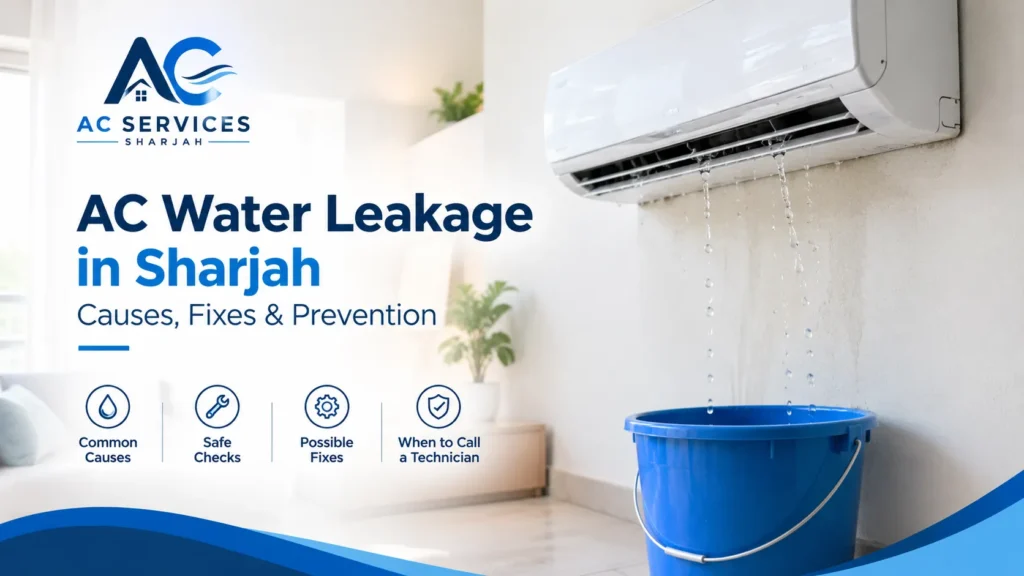
If your AC is leaking water inside your Sharjah home, the problem is usually related to condensation not draining correctly. A clogged drain line, dirty filter, frozen evaporator coil, damaged drain pan, or low refrigerant can all cause water to appear around the indoor unit.
In Sharjah’s hot climate, air conditioners run for long periods and continuously remove moisture from indoor air. When the drainage system cannot handle that condensate properly, you may notice dripping from the indoor unit, water collecting on the floor, or damp patches around the AC.
Why is my AC leaking water inside?
The most common reason for an AC water leak is a drainage problem. During normal cooling, moisture condenses on the indoor evaporator coil, collects in a drain pan, and should leave through the condensate drain line. If that path becomes blocked, water can back up and overflow.
Other problems can create a similar symptom. A dirty filter may restrict airflow enough to freeze the evaporator coil; when the ice melts, the resulting water can overwhelm the drain pan. Low refrigerant can also contribute to coil freezing and should be professionally diagnosed.
1. Clogged AC drain line
A blocked condensate drain is one of the most common causes of water leaking from a split AC.
Dust and airborne debris can mix with moisture around the indoor unit and gradually form buildup inside the drain system. Algae or other biological growth can also contribute to blockages.
When the drain line is restricted, condensate has nowhere to go. Instead of flowing outside, water backs up into the drain pan and eventually spills from the indoor unit.
Common signs include:
- Water dripping from the indoor AC
- A puddle underneath the unit
- A musty smell
- Water appearing after the AC has been running for some time
- Slow or no water discharge from the drain outlet
For a persistent blockage, professional AC repair is safer than repeatedly running the system and allowing water to collect around walls, ceilings, flooring, or electrical components.
2. Dirty air filter
A heavily blocked filter restricts the amount of air passing through the evaporator coil.
Reduced airflow can cause the coil to become excessively cold and freeze. Once the ice melts, the additional water can overflow the drain pan and appear as an AC leak.
This is one of the first things a homeowner can check because the filter is normally accessible without opening the refrigeration system. Carrier recommends regular filter inspection and replacement, with the exact interval depending on the system and operating conditions.
If your AC filter is visibly covered with dust, replace or clean it according to the manufacturer’s instructions. If the unit continues leaking afterward, the filter probably isn’t the only issue.
3. Frozen evaporator coil
If you see ice or frost around the indoor coil, don’t assume the AC simply needs more refrigerant.
A frozen evaporator coil can result from restricted airflow, dirty filters, inadequate airflow through the system, or refrigerant-related problems. When the ice eventually melts, water can drip into areas where it should not.
Turn the system off and allow the ice to melt rather than continuing to operate an AC that is visibly frozen. If freezing returns after the filter has been checked, arrange for a technician to diagnose the underlying cause.
4. Low refrigerant or a refrigerant leak
Low refrigerant can contribute to evaporator coil freezing, which may eventually result in water leakage.
However, refrigerant is not something that should simply be “topped up” without finding out why the level is low. An air-conditioning system is designed as a closed system, so a significant loss of refrigerant can indicate a leak.
A technician may need to locate the leak, repair the affected component or pipework, test the system, and recharge it to the manufacturer’s specified level.
If your AC is leaking water and not cooling properly at the same time, professional diagnosis becomes more important.
5. Cracked or damaged drain pan
The drain pan catches condensation from the evaporator coil before it enters the drain line.
If the pan becomes cracked, corroded, displaced, or damaged, water may escape even when the drain itself is clear. A dirty or overflowing pan can create a similar problem.
A technician can inspect the pan and determine whether it needs cleaning, repositioning, repair, or replacement.
6. Drainage or installation problem
Sometimes the problem isn’t a blockage at all.
The indoor unit and condensate pipe need to be positioned so that water can flow correctly toward the drainage point. A poorly positioned drain pipe, incorrect slope, kink, or installation issue can prevent condensate from leaving the unit.
This is particularly worth checking if the leakage started shortly after an AC installation, relocation, or major repair.
What can I safely check before calling for AC repair?
You can perform a few basic checks without opening the AC’s electrical or refrigeration components.
- Turn the AC off if water is actively dripping.
- Check the air filter and clean or replace it if it is heavily dirty.
- Look for visible ice around the indoor unit or accessible coil area.
- Check for standing water around the indoor unit.
- Look at the visible drain outlet if it is safely accessible and check whether water is draining normally.
- Protect nearby furniture and flooring from further water damage.
Do not remove electrical covers, disconnect refrigerant lines, or attempt to recharge refrigerant yourself.
If basic checks do not identify the problem, professional AC repair is appropriate.
When should you call an AC technician?
Call for professional AC repair if the leakage continues after checking the filter, the indoor coil is freezing, the AC has stopped cooling properly, or water is repeatedly collecting around the indoor unit.
You should also arrange an inspection when the leak is coming from inside a ceiling-mounted system or when water is reaching electrical components, walls, ceilings, flooring, or furniture.
A technician can trace the leak instead of treating only the visible water. Depending on the symptoms, the inspection may include the drain pan, condensate pipe, evaporator coil, airflow, refrigerant condition, and installation of the drainage system.
For homeowners who need broader help, see our AC repair services in Sharjah and AC maintenance services in Sharjah for related service information.
AC water leakage: quick diagnosis guide
| What you notice | Possible cause | What to do |
|---|---|---|
| Water dripping from indoor unit | Blocked drain line | Turn off AC and arrange drain inspection |
| Ice on indoor coil | Restricted airflow or refrigerant issue | Check filter; call a technician if freezing continues |
| Dirty filter + water leak | Restricted airflow | Clean/replace filter and monitor |
| Water continues after filter change | Drainage or mechanical issue | Professional inspection |
| AC leaking and not cooling | Refrigerant, airflow or coil problem | Arrange AC repair |
| Water from damaged pan | Cracked/corroded drain pan | Technician inspection and replacement if required |
| Leak started after installation | Drainage or installation issue | Have installation and drain slope checked |
How can you prevent AC water leakage in Sharjah?
Regular AC maintenance can reduce the likelihood of drainage and airflow problems, particularly when the system operates for long periods.
Keep the air filter clean, make sure the indoor unit’s drainage path is not obstructed, and have the drain system and coils inspected as part of scheduled maintenance. Carrier and the U.S. Department of Energy both identify filter condition and condensate drainage as important parts of air-conditioning maintenance.
Sharjah’s dusty conditions also make airflow and cleanliness worth monitoring. If your AC is exposed to significant dust, construction activity, or frequent indoor dust accumulation, the filter may need attention more often than a system operating in a cleaner environment.
The goal isn’t simply to clean the AC more often. It is to catch problems such as restricted airflow, blocked drainage, or abnormal freezing before they turn into an indoor water leak.
Frequently Asked Questions
Is it safe to use an AC that is leaking water?
It is better to switch the AC off when it is actively leaking, particularly if water is reaching flooring, walls, ceilings, or electrical components. A leak can indicate a blocked drain, frozen coil, damaged pan, or another fault that needs attention.
Why does my split AC leak water at night?
The underlying cause is usually not the time of day itself. A partially blocked drain, restricted airflow, frozen coil, or damaged drain pan can become noticeable after the AC has been operating for several hours. If the leak repeatedly appears at night, check the filter and arrange an inspection if the problem continues.
Can a dirty AC filter cause water leakage?
Yes. A heavily dirty filter can restrict airflow across the evaporator coil. This can contribute to coil freezing, and the melting ice can result in water overflowing from the drain system.
Does low refrigerant cause an AC to leak water?
Low refrigerant can contribute to evaporator coil freezing, and the melting ice can then produce water leakage. However, water leaking from an AC does not automatically mean refrigerant is low. A technician should diagnose the cause rather than adding refrigerant without checking the system.
How quickly should an AC water leak be repaired?
An active leak should be investigated promptly, especially when water is pooling indoors or reaching ceilings, walls, flooring, or electrical components. Switching the AC off can help limit further water damage while you arrange an inspection.
Need AC repair for a leaking unit in Sharjah?
A leaking AC is often caused by a relatively straightforward drainage or airflow problem, but the visible water does not always reveal the real fault. If cleaning the filter doesn’t resolve the issue, or you see ice, repeated leakage, poor cooling, or water damage, have the system inspected rather than repeatedly restarting it.
For related problems, see our AC services in Sharjah, AC repair in Sharjah, and AC maintenance in Sharjah pages for the appropriate service information.